Monday, April 24, 2017

A Human Pincushion

Next January I’ll be 20 years into my career in data analysis.  I actually have “data” in my job title.  So of course when I was diagnosed with Type 1 Diabetes I figured I had an advantage.  I don’t know if that’s actually true in practice, but it certainly means I spend a lot of time thinking about numbers.  What I hadn’t really thought about was getting a little more perspective on those numbers.  I know how many units of insulin I take for different foods and how many needles and test strips are in the prescriptions I fill every 3 months…but I never thought about what that all looks like.  With that in mind, I decided to spend the month of March finding out.  I saved every needle and every test strip for 31 days to see what I do so I could share it here for perspective.  I’m the one poking all these holes in myself every day, but seeing the volume of them was shocking.  And the exercise left me with something of a biohazard on my hands!

Every day in March I put all of my needles into a plastic cup in my kitchen.  If the month extended to 32 days I wouldn’t have been able to maintain the delicate balance at the top of this pile.  For context on size, the object behind the cup is a Kitchen Aid mixer with the awesome cover my mom made for me.  It only took a few days for me to be awed by the volume accumulating at the bottom of the cup.  
At the end of the month I counted the needles and set them up in rows to get the full effect.  How many?  That’s 248 needles, an average of 8 per day.  Most days are less and a different month would be somewhat lower.  March had some weekends away from home that included beer, which means I was dosing more often than usual.  Things don’t take long to add up.
I also kept all my test strips throughout the month.  There’s no cute way to display these, and I kept them in a Ziploc bag until it was time to count.  Even with my CGM keeping tabs on my blood sugar, I test a lot.  That’s 292 strips almost filling half a cup, an average of over 9 per day.  I’m actually curious as to whether that number would go down if the beer I mentioned hadn’t happened.  I was testing an average of at least 9 times a day before I got my Dexcom, and I’m not conscious of testing that frequently now.  I’ll probably test it again for a week some time to see how the numbers come out.
Between injecting insulin and checking my blood sugar I poked 540 holes in myself during March.  That’s somewhat surreal to realize, and I’m the one actually poking each of those holes.  I poke those holes every day with no time off for good behavior.  I don’t do it to cure my disease; I do it to stay alive and healthy.  I downplay what goes into T1 pretty regularly, but make no mistake – this is a lot of work.  It’s also a whole lot of puncture wounds.

For some additional context I thought I’d show what I mean when I talk about insulin doses. One example was when I described accidentally injecting 27 units of Novolog (fast acting insulin) instead of Toujeo (basal insulin).  With all the images of the needles and test strips that I go through in a month I thought it might be meaningful to show a unit of insulin.  The pictures below shows a single unit of insulin in the same measuring cup the test strips are in above.  That’s it, one unit down there in the center.  Making a miscalculation in a dose of just one or two of those units can be the difference between normal blood sugar and a shaky, scary low, or even a trip to the hospital.  That’s my margin of error, a drop you can barely see in a photo.  I zoomed in so you’d be able to see it at all.
What’s my point with all of this?  My goal was and is showing the scale of what goes into managing T1.  I’m not complaining; I didn’t know what to expect when I started saving all these scraps.  But in hindsight I can also say that the next time I say “it’s fine,” or “it’s no big deal,” I might also remember I have to stab myself over 500 times a month to stay alive.  So yeah, I’ve got this.  But 500 holes a month is 6,000 holes a year.  That’s kind of a big deal.

Tuesday, March 14, 2017

It's a Small World

If you read my posts on Facebook you know that last month I was on vacation at Disney World with my mom.  We’ve vacationed together each year since 2002 to celebrate our birthdays, which are 4 days apart.  Over those years airport security has increasingly become an adventure, as Mom has had more pins, screws and replacement parts added.  She lights up a scanner!  This year was our first trip since I added the continuous glucose monitor (CGM) to my Type 1 Diabetes management, and I warned her ahead of time that I’m now the bigger problem for the TSA.  She was shocked to see I was right.  First, I sent 3 insulin pens through the x-ray machine – which got my tray pulled for further inspection on both ends of our trip.  There are 2 different responses when I explain that what they’re holding is insulin.  The first is an understanding nod before handing them back.  The second is total confusion and seeking out other TSA agents to get help.  Fortunately, that second level has always let me through without further question.  The bigger problem is that I can no longer go through the scanner, because Dexcom doesn’t know how the sensors will respond.  This is the part inserted in my arm, where I make sure to have the sensor inserted every time I travel so that it’s easy to reveal to security without getting undressed.  That means that I have to opt into the pat down every time I fly.  I don’t mind it (free massage!), so far everyone has been respectful and to an extent even apologetic.  I’m the one choosing the hassle, so I can’t fault them for doing their jobs.  But for the first time in a long time, now Mom is the one waiting on the back end of security while I get 2, 3, and sometimes even 4 levels of attention.  All she could do was laugh.  We’ve been traveling long enough that we’ve gone from a senior citizen threat to national security to a middle-aged diabetic gumming up the works.  Bear with me if you’re ever stuck in security behind me, I’ve become the person you usually curse at.

There’s an overdue blog post that ultimately needs to happen about vacations, family and food, but this isn’t that post.  What I want to talk about are the people I encountered while we were out of town, and a recent decision I’ve made.  The numbers I see online are that there are either 1.5 or 3.0 million people living with T1 in the United States.  As someone who analyzes data, I find that range ridiculously large and it tells me that we really don’t know other than…it’s not a lot of people as a percentage of the population.  Yet I seem to run into T1s or people affected by T1D everywhere I go, and I had 3 of those experiences on this vacation.  On our trip to Hollywood Studios I wore my “T1D Looks Like Me” shirt and a gentleman approached me out of nowhere to ask if I have T1.  He explained that he was a bike mechanic and supports the JDRF fundraising ride every year in Grand Rapids, just an hour or so from where my family lives in Michigan.  The second T1 run in was one night at dinner.  As I was injecting insulin before desert, a young server walking by exclaimed “I use that kind of insulin too!”  That was a first for me.  And finally, on the day we went to Universal Studios, a security guard going through my purse pulled out the cold pack with one of my insulin pens.  He had no idea what to do with it, but his partner quickly said it was either insulin or an EpiPen.  She knew about the insulin because she also has T1D.  I told her I was diagnosed just a couple of year ago, and as we walked away she said “it gets easier.”  I told her it already has, and we headed off to the park.  It fascinates me the number of T1 people I run into.  If there are so few of us, why do I meet these people so frequently?  We didn’t go to the Magic Kingdom on our trip this time, so I’ll spare you any “It’s a Small World” puns and just leave that ear worm out there for you to enjoy.

That last line from the security guard is something I’ve thought about a lot.  For me it has gotten easier.  T1 is changing me in ways beyond the physical, and it’s all positive.  This is never easy, but most of the time it’s as significant a part of my routine as brushing my teeth.  As I’ve said in a previous post, I had to learn about managing T1 largely on my own and from strangers on the internet.  So when I got an email from the local JDRF chapter looking for people to volunteer as mentors to newly diagnosed people, I realized this may be a chance for me to help someone starting their T1 journey.  I’m generally not a joiner, so this is outside of my normal reaction.  But having T1 is so outside the norm that I feel like I have to go outside my comfort zone for this one.  So I’m heading to the JDRF office after work this Thursday for mentor training.  I’m hoping to be paired with recently diagnosed adults rather than the parents of recently diagnosed kids.  Not that I can’t talk about T1 with parents, but I can’t accurately relate to their experience.  I don’t know what will happen, who I’ll meet or how it will go, but I’m giving it a shot.  If nothing else comes of it, hopefully I can help some people believe that eventually, after you get through the denial and fear and confusion and all the other myriad emotions that come with a T1 diagnosis, it really does get easier.

I tortured my mom while we were at Disney and demanded she cooperate with a few photos.  Fortunately, she humored me a couple of times.  This is soon after we rode Expedition Everest at Animal Kingdom.  Thanks, Mom.


Sunday, January 8, 2017

I Overdosed on Insulin

After 2.5 years of T1D, a lot of managing my disease happens almost on autopilot.  Generally giving myself insulin is just something I do before I eat, and because I know the right dose for most of my meals it doesn’t take more than a second of thought to get it done.  Sometime between 8 and 9 every night I also take my “nightly,” the basal insulin that maintains my blood sugar throughout the day beyond the insulin I need to cover food.  Autopilot, day after day.  Such automatic movements that I absentmindedly screwed the whole thing up.

At about 8:30 last Friday night at a hockey game, I gave myself my usual nightly shot.  But right as I injected the full 27 units into my stomach I realized I’d used the wrong pen.  Without thinking, I’d given myself enough fast acting insulin to cover approximately 135 grams of carbohydrate.  To put that into context, that’s the equivalent of 2 large orders of french fries at McDonald’s or 4 slices of a large pizza from Domino’s.  Or even more fun, an entire pint of Ben & Jerry’s Chocolate Fudge Brownie ice cream.  But I hadn’t eaten any of those things, so suddenly my friend and I had a bit of a crisis to address.  This was a major T1 “oh shit” moment.

I’ve read stories online about people using the wrong insulin and I’ve admittedly been pretty judgy about them.  How could you possibly do something so stupid when the 2 pens are so unmistakably different in appearance?  That’s what I get for being quick to judge.  I’m far from perfect, so what makes me immune to making a colossal mistake?  Nothing at all, and it bit me in the behind.  I ran on autopilot, overdosed in a big ugly way, and…can’t honestly say it will never happen again in half a lifetime of T1D.  I felt stupid the first time, I’m sure I’ll be mortified a second.

What happened after I overdosed?  I immediately ate a handful of really unpleasant “tropical fruit flavors” glucose tablets, followed by multiple handfuls of peanut butter M&Ms and then most of a giant order of french fries from Michael Symon’s B Spot restaurant.  I was going to eat my burger with the bun, but even in a crisis I couldn’t do it – the bread to meat ratio was too high and ruining a really good burger!  In the end we got through the whole thing without needing a trip to the ER.  My sugar bottomed out at 59 around 9:45 PM and finally started climbing around 2 AM until it spiked to 249 a little after 3 AM.  It was not a good night, but there’s no truly great outcome of that kind of mistake.  The end result was I survived and that’s what matters most.

What did I learn from my OD?  That handling T1 has become so routine I often don’t give it any thought.  There’s good and bad in that.  Mostly I’m calling it a good realization that a miserable and stressful disease is typically just part of the routine for me.  At the same time I need to be more mindful about the decisions I make.  I was reminded that I’m generally pretty calm in the face of a crisis…and that watching someone else’s health emergency is terrifying, as evidenced by my friend admitting she was panicking.  And I learned yet again that T1 won’t stop me because there’s nothing here I can’t handle.

Happy New Year, everyone.  Here’s to a healthy, happy 2017 filled with good decisions and with ridiculous blunders kept to a minimum.  I’ve been quiet on the blog for the last 2 months, I’ll try to get back into the swing over the next few weeks.  Thanks for being part of a great 2016.

27 units of Novolog was a bad idea!

Monday, November 14, 2016

Positively Diabetic

Earlier this fall a guest speaker came in to my company, accompanied by his wife and service dog.  Along with topics related to accommodating and addressing disability in the workplace, he discussed “disability positivity.”  This man was born with cerebral palsy spastic quadriplegia – physically there isn’t much he can do other than some small control of one hand.  But the talk he and his wife gave was about being positive and was often laugh out loud funny.  Sure, he admitted to being frustrated by his disability at times.  Most recently before that presentation he was denied entrance to the flight from his home in Toronto to my company in Cleveland because of the size of his wheelchair (see the story here).  But he also pointed out the positives, like being more creative in life at problem solving because of things he can’t physically do.  The whole presentation got me thinking…what are the positives in my Type 1 diagnosis?  Clearly a list is in order.  All of these are true, though some are much funnier than others! 

In no particular order, the positives of living with T1:
  • I’m much more motivated to go to the gym, which may help me keep my toes in the long run.  I can’t afford for my feet to be any smaller, I wouldn’t be able to reach the gas pedal!
  • I have an excuse to eat candy in bed.  Not something I ever dreamed about, but now I have an assortment next to me every night in case of lows. 
  • I get to see the many amazing colors bruises can turn.  Technicolor!  Every injection is a mystery…will I bruise this time or not?
  • When I needed to take blood thinners after ankle surgery I wasn’t stressed out about another daily needle to the stomach.
  • I’ve learned about the incredible people who fight this disease, including some inconceivably tough kids like Luke and River.
  • I’m science fiction in motion, with a gadget attached to my arm that tells not only me what my sugar is doing, it tells my friends no matter where they are.  Beam me up!
  • I get to buy increasingly larger purses to accommodate all of my D-stuff.  Why wouldn’t I want to take luggage with me everywhere?  I’m trying to learn to appreciate a giant bag.
  • I carry portable meat in my giant purse for when I need a snack.  Portable meat.
  • I’m a part of an active online community of people with T1D where I continue to learn about fighting this disease, help others learn how to fight and where I have a 24x7 sounding board to vent to people who understand when things just don’t go the way I want.
  • I’ve been exposed to the wonderful world of skin adhesives.  That space gadget on my arm won’t stay there long without extra help.
  • I’ve developed a strong affinity for sugar free strawberry jell-o and chocolate pudding.  Don’t judge.
  • I’m more patient with myself.  There are variables in play that I can’t see or feel, and those affect my results.  I’d love to see what my sugar was right before we jumped out of that plane skydiving, but I had to leave my phone on the ground and out of range.
  • I’m better at meal planning.  It’s easier to do all my cooking in advance than worry about what they’re serving for lunch in the cafeteria or what I’m going to eat if I don’t get home until 8 PM.
  • I’ve discovered the largely invisible “diabetes” section at pharmacies.  Be honest, you didn’t know I had a section all my own where they sell things like socks and portable glucose.  No, I don’t wear diabetic socks.  But you’ll notice them the next time you’re at CVS!
  • I was diagnosed as an adult.  Why is that a positive?  Because though this may cause my parents some stress from time to time they’ll never have to live with the ups and downs and go through sleepless nights managing my T1D for me.  I caused them more than enough stress growing up!
  • I’ve developed a sixth sense for Sharps containers where I can dump the used needles I’m carrying around.
  • I’ve discovered the joy of glucose tablets.  Raspberry is delightful, orange is tolerable, chocolate marshmallow should have been destroyed 5 minutes after it was created.  I’m starting to search for new flavors online to expand my sugar palate, but I recently found “citrus punch” and “tropical fruit” at CVS.  We’ll see which end of the ratings they land on!
  • I learned that my immune system is amazing.  People say that diabetics get sick more often and are slower to heal injuries, but my immune system is so powerful it killed off a perfectly good pancreas.  I’m unstoppable.
  • Wearing a CGM means I can’t go through the scanner or x-ray machines at the airport.  Free massages from TSA every time I fly!
  • Because there are many ways to treat low blood sugar, beer has probably saved my life more than once.
  • I get to do my part to educate people about T1D.  Until I was diagnosed I knew it as the diabetes that kids get, and had no idea how serious it was.  Now I’m able to share my experience to raise awareness and change perceptions.
  • I have a blog!

Why do I carry a giant purse now?  Here's what I carry daily to take care of my T1D.  A glucose meter, needles, 2 types of insulin and a chilled pouch to keep them cold, needles, test strips, pepperoni sticks to snack on, M&Ms and glucose tablets to correct a low blood sugar plus a protein bar for before the gym.  I'm ready for anything!


Tuesday, November 1, 2016

Awareness Month!

November is Diabetes Awareness month.  When I was first diagnosed with Type 1 I didn’t tell many people; I’m pretty sure I waited a year before mentioning it on Facebook.  Last November I didn’t mention awareness month, change my FB profile picture or do anything else to draw attention to T1D.  A year later I’ve created a blog, proudly wear a t-shirt that says “Type 1 Strong,” and started looking on the JDRF web site in October to see if they were still doing the “T1D Looks Like Me” profile pictures.  What a difference a year makes!

What changed?  I didn't want to stay quiet anymore.  I have a highly misunderstood chronic disease that affects millions of kids and adults and very few people have any clue what Type 1 means.  I want to raise awareness, I want to support research efforts towards new treatments and a much needed cure, and I want the people I care about to understand my fight.  I wear a bracelet every day from a group called Beyond Type 1 that says “educate, advocate, cure.”  I wear it to remind myself how important it is to educate people about T1.  While I feel unlikely to do something like meeting with my elected representatives to advocate for increased T1 research funding, I feel like what I do here serves a similar purpose – I’m advocating for myself and everyone else with T1 by teaching people about our disease.  Though I can’t directly do anything about finding a cure, I’m able to donate and raise money for an organization like JDRF that can.

So here I am.  I can’t change the world, but I can try to change my tiny little piece of it.  I started this blog hoping to make sense of this for my parents and close friends, and now I’m reaching not just those people but friends from high school and college that I haven’t seen in over 20 years.  That’s amazing to me.  I realized this weekend while I was visiting my family in Michigan that I still have plenty to share.  As much as I’ve explained since I was diagnosed, and as much as I’ve described online, my dad learned a lot about T1 in the time we spent together.  He didn’t like what he saw, but I’m glad he got the extra insight.  I’m even happier that he got to see me fight through it.  You’re right Dad, my T1 is a schmuck!  I couldn’t have said it better.

It’s hard to do justice to T1 in writing sometimes, but I’ll keep trying.  On day 1 of this Diabetes Awareness month, I’m grateful I have the chance to share my stories with all of you.  Thank you for your support and your interest in hearing what I have to say.  Educate, Advocate, CURE.


Sunday, October 23, 2016

What Is That Thing?

On my recent vacation in Las Vegas I wore tank tops most of the week, which meant my continuous glucose monitor (CGM) was in full view on the back of my right arm.  2 people asked what it was, a whole lot of others tried not to get caught staring.  I notice the same thing at the Y when I’m on a treadmill; people are curious but uncomfortable asking, and throw side glances while they walk or run.  Not everyone will feel the same as I do, but my advice is this – if you see someone wearing a medical doohickey they’ll probably welcome your questions.  If I wasn’t OK with you seeing it I’d put it somewhere else or wear longer sleeves.  And while I’ll happily give you a quick lesson on the fun toy stuck to me, I promise not to bore you with a 10 minute preachy spiel.

For those who didn't see it when this picture from Vegas was on Facebook, here's the highly noticeable gizmo on my arm (and my terrible posture).  We'd stopped for a few minutes to watch the 4th quarter of the Michigan/Wisconsin game and my friend took the picture while humoring me with a game she didn't care about.  If you look close enough you can see the fireworks sticker I added to the transmitter from Pump Peelz.  


Anyway, it’s been almost 4 months since I started wearing my CGM, so I thought I'd give an update on how things are going.  As a reminder, the CGM is a device with a tiny wire inserted under my skin connected to a transmitter that provides glucose readings every 5 minutes.  I get those readings on my iPhone and 3 friends also get those readings on their phones in real time.

My overall thought?  I love it.  One of my favorite parts is being able to watch my sugar while I’m at the gym.  On one hand it’s just cool to watch the number drop as I walk.  Typically after about 20 minutes things start trending down, so it doesn’t take long.  More importantly, it tells me when my sugar is starting to get too low.  That lets me throw back some glucose without missing a beat and without worrying about the potential for some kind of catastrophic flight off the end of a treadmill if I get way too low.  Though yes, I know some of you would pay good money for that video.  Not happening!

The biggest minus of my CGM is that sometimes it’s really wrong.  An alarm on my phone goes off for any glucose reading under 55.  Four times recently a transmitter has decided I was around 50 in the middle of the night, setting off that alarm on my phone and my friends’.  That alarm is a big part of why I wanted a CGM in the first place, but more than once I’ve gotten out of bed to check manually and found my sugar was a perfectly healthy 100.  Thanks for that, Dex.  Nobody really wanted to sleep through the night anyway!  Why are the readings wrong?  Sometimes because it's time for a new site and I need to move the transmitter to somewhere else on my body.  Technically you’re supposed to move it every 7 days, though like most people I stretch that as long as I can if it’s still working and is reasonably well stuck to my skin.  Other times readings get screwed up or even temporarily cut off if I’m laying on the body part the transmitter’s in.  Since I don’t lie just in one spot all night it’s kind of hard to avoid that in my sleep.  And like everything else with T1, sometimes it’s wrong because the thing just glitches.  That’s all I can figure out, anyway.  If I drop from 90 to 50 in 5 minutes, I label that a glitch.  I don’t think that kind of dramatic change has been right yet.

Accurate or not, those low alarms in the middle of the night don’t just go off at my house.  That’s both a plus and a minus.  There are 3 people who have been willing to follow my CGM data and that’s a big deal to me.  My biggest goal with getting this was safety, and I’ve asked these friends to be my back up when I may not be able to take care of myself.  But that also means waking them up!  There have been a couple of times already where I’ve needed an adjustment to my insulin dose or my body seems to be a bit out of whack and I wind up going low multiple nights in a row.  That means we all wake up, I text them that I’m OK, and we all try to go back to sleep.  Not a big deal in the grand scheme of things, but I feel guilty when it happens.  More than once I’ve eaten some glucose or M&Ms because it looked like I was dropping and I wanted to make sure I didn’t wake anyone up.  I realized just recently though that I’m the only one of the four of us who hasn’t slept through any of the low alerts yet.  Yet.  Good thing we can all back each other up. J

Another annoyance with the Dexcom is keeping it on me.  While there’s a wire under my skin, the whole operation is kept together by adhesive that glues the CGM to the surface.  I’ve struggled with this part and haven’t found the ideal solution.  My record is now 26 days, for that site on my right arm that went skydiving in Vegas.  There’s no way to predict how well it go, and several sites lately have barely made it through the 7 days the company promises.  I’m working my way through suggestions I’ve found online (like the colorful and fun Grif Grips!) , and my next step is going to be trying to put Skin-Tac adhesive on my arm before I stick the sensor down.  After that I’m aiming for kinesio tape because I’ve heard some people have luck with using that around the edges.

As I write all this down I realize that I’ve listed a bunch of negatives that might contradict me declaring my love for this gadget.  Besides stalking my own sugar on the treadmill, one of the big advantages is keeping tighter control of my health.  I saw my endo a couple of weeks ago and was hoping for an A1c of 5.7.  I wound up hitting 5.6 and tied my all time low.  In non-T1 adults that result is considered non-diabetic.  So on average, I'm doing a decent job playing the role of my pancreas.  I can react faster to changes in my sugar now and that helps me prevent some highs and resolve others sooner than I’d know about them otherwise.  A lower A1c means I’m pulling off tighter management of my glucose and hopefully reducing my risk of complications from T1D.  Doing that with a CGM that warns me when I’m low means doing it as safely as I can, so I’m willing to accept a few false alarms.  My doctor was so pleased with my trend over the last 3 months that he joked about framing the graph I printed for him, and he cut me down to only 2 appointments a year instead of the 4 visits most T1s have.  That's a pretty good place to be!


Sunday, October 9, 2016

The End of the World?

“It’s the End of the World as We Know It” is from one of my all time favorite bands, R.E.M.  When I was diagnosed with Type 1 I had an R.E.M. CD in my car with that song and I was playing it frequently.  Every time the song played I wound up in tears.  I can’t tell you how long it continued, I don’t remember.  At least for a few weeks and probably longer, and I never discussed it with anyone before now.  I felt like it was the end of the world because I was terrified about what my new disease meant and what was coming.  There are plenty of things to be worried about!  It takes some time to come to terms with them all.  Sometimes I’m still not sure I have, but I keep trying.

On the day my endocrinologist gave me that first shot of insulin, I told the friend who was with me that it meant I would die early.  I held off on crying until after we made it to the parking lot (victory!), but then I lost it.  I didn’t know what diabetes meant but I was pretty sure it involved a shorter lifespan.  The reality is that it might and it might not.  The most recent information I’ve seen is that Type 1 shortens the average life expectancy by 12 years.  Ouch!  Since I don’t know what my life expectancy was before I was diagnosed, that isn’t quantifiable.  I don’t know what I would have gotten, so I don’t know what (x – 12) is.  And since it’s an average, it means plenty of people lose less than 12 years, others lose more and some even gain time.  When we were in grad school, my roommate and I made bad statistics jokes.  One was “skew the distribution in your neighborhood,” a play on Mr. Rogers.  I don’t want to be average; I want to skew that distribution to the high side and I’m doing what I can to get there.  I’m also hopeful that being diagnosed in my 40s means my odds are improved since that means 30-40 years less damage from high and low blood sugars in my body.  We’ll see how things turn out, but I’m planning to stick around for a long time.

At that same early endo visit, he told me I needed to start taking a statin to lower my cholesterol.  I declined immediately and we debated the subject for a few minutes.  I’ve done a lot of reading about cholesterol and am comfortable with my test results and lack of family history.  My doc agreed to let the issue go.  But in the next sentence he tried to scare me into changing my mind when he said “we’ll revisit it after you have a stroke or heart attack.”  We actually revisit the subject every time I see him when he reminds me again that I should be eager to start my statin regimen.  It’s not happening, but he’s going to keep trying to scare me into obedience.

The statin chat is my favorite example of managing diabetes with fear.  But then there are the other fun things to worry about over time.  When I told my eye doctor about my diagnosis he happily shared that we have some of the top retina specialists in the U.S. available right here in Cleveland.  Awesome!  But…I’d really rather not need to see any of them.  Each time I see the endo he asks if I’m checking my feet daily for injury.  Why my feet?  Because any unnoticed injury could be the one that ultimately leads to amputation of a toe or a whole foot.  Neuropathy from high sugar could mean I wouldn’t notice that I stepped on a rusty nail.  Circulation problems could lead to poor healing or higher risk of infection, and then they could need to remove that part of me.  Not something I’m interested in, thank you.  And one more that I forget about – when I was diagnosed with high blood pressure around the same time as T1, I asked why I was prescribed the specific medication I was given.  The reason for that drug?  It will help protect my kidneys from the damage diabetes can cause.  Oy vey.

My point here isn’t to scare anyone or to say that I expect to leave this world prematurely, blind and 7-toed.  My point is to explain that so much of Type 1 is about fear and the language of fear.  Nobody’s ever going to say I’m the most optimistic person they’ve ever met.  No chance of that! I’m often the sarcastic cynical in any crowd and all the possibilities of T1 scare me.  Of course I worry about the long term complications that could hit me down the road.  But I’m not good with living filled with fear and anxiety.  I prefer to think that I’m fighting and I’m winning instead of that I’m biding my time until I have the heart attack my doctor believes I’ll assuredly drop dead from without his help.  This is a chronic disease that can kill me and everyone dies from something wearing a pile of scars from experiences good and bad.  There’s no guarantee that T1 is going to get me and I’ll keep doing everything I can in the meantime so that something else gets me when that day comes.  I’m planning to go out with my eyes and toes intact, thank you very much.  Living in fear is way too much work.  I’m living my life.

On the side of positive reinforcement there are 2 organizations I’m aware of that celebrate lives lived successfully with T1 and both send medals to commemorate significant diagnosis anniversaries.  Lilly Diabetes awards medals at the 10, 25, 50 and 75 year marks.  The Joslin Diabetes Center also awards medals after 50 and 75 years of living with T1, and a certificate after 25.  Why are they giving out awards for reaching T1 milestones?  Because it isn’t easy to do and because it was impossible to reach those goals not so long ago.  I’m not holding out any hope for 75 years, but I’m aiming for those 50 year medals and can guarantee I’ll submit my application each time I hit one of those marks.

The pictures from my first skydiving experience tell the whole story.  I couldn't stop smiling before, during and after the trip of a lifetime.  Living!


Saturday, September 10, 2016

Yes, I Can Eat That

I eat all the time.  That’s not much of an exaggeration…most days I eat 3 meals plus somewhere between 3 and 5 snacks.  Eating is an all day activity!  When I’m out with friends they often cut themselves off right as they start to ask “are you hungry,” because my answer 99% of the time is “I could eat.”  That has nothing to do with having Type 1, it’s just how I’ve been for probably 20 years.  And so when I was thinking about topics to write about, I thought about food.  I’ve talked about the day to day experience of living with Type 1 diabetes, and about how it feels to go through highs and lows.  I didn’t plan these posts out to follow a deliberate path, but food is a relevant part of the discussion after what I’ve written about so far.  Food with T1 is a subject that gets a lot of discussion, both in the T1 community and in my own life with anyone who sees me eat.  To understand how food fits into my life with Type 1, it helps to know a little of my history with food before diabetes. 

Nearly 10 years ago I realized I wasn’t happy with my weight.  Up until that point my diet for a typical day included animal crackers out of a vending machine for breakfast, fast food or the cafeteria for lunch and often pizza for dinner.  It wasn’t that I didn’t cook; it’s that it didn’t happen much.  Nearly everything I ate was carbohydrate with a side of carbohydrate, and it wasn’t working well for me.  Right before my 35th birthday a friend reminded me that I’d had some success with a low carb diet when we were in grad school, so I decided my birthday was the kickoff date for my lifestyle change.

Through the next 12 months I cooked nearly all my meals, I was hardcore about what I ate, and typically the only carbs in my diet were the few found in eggs, shredded cheese and dried seasonings.  It worked, I lost over 20 pounds and I kept it off.  Success!  I lost weight and gained energy, and realized that I’d found a lifestyle that worked for me.  I call it a lifestyle and not a diet because it wasn’t a temporary plan I was following to drop a couple of pounds.  I lost my cravings for pizza, French fries and my favorite work day snacks of Fritos and Cheetos.  From then on I continued cooking most of my meals and keeping them extremely low in carbs.  I’d go off the rails on vacation or isolated occasions, but the rest of the time I stayed generally on plan because I liked both what I was eating and how I felt.

Fast forward to 2014, and I was still typically eating 3 home cooked meals a day.  I’d put some of my weight back on.  And then I started losing weight.  I lost weight no matter what I ate.  I could share a pint of ice cream with a friend and lose 3 pounds overnight.  I got back to my goal weight!  Unfortunately I got back there because of the T1, which I didn’t know until I was diagnosed with diabetes.  As soon as I was diagnosed, I knew I needed to go back to what I knew and believed about food and what would be healthy for me:  eating low carb and high fat.

The truth about food with T1 is that I can eat whatever I want.  I’m no different from a non-D person in that sense.  One of the best explanations I’ve seen was from someone on the Beyond Type 1 app.  A friend saw what this person was about to eat and asked “won’t you need insulin if you eat that?”  The well done and completely accurate answer they gave was “yes, and so will you.  The difference is that your body still makes it, I have to inject it because mine can’t.”  I can have pizza and fries and ice cream and margaritas, but I need to put a lot of thought and planning into them.  Since getting that right, and really truly right isn’t that easy, I choose to leave the carbs out most of the time.  And though my weight isn’t where I’d like it to be right now, it stays lower than it would be if I was eating all those fun foods.

That’s not to say I don’t indulge, it’s just that I apply a “needle worthy” filter to my choices.  I haven’t had chicken tenders since my diagnosis.  Is that a life-altering food loss?  Not even close, but because I’ve decided not to eat them I miss them.  My dad makes amazing French toast.  I haven’t had that since my diagnosis either, but I’ve already let my parents know I’d love to have it one morning when I’m in town for Thanksgiving this year.  It’s 100% needle worthy and I’ll put up with whatever follows.

This is a personal choice.  A lot of people with T1 don’t eat low carb and that works for them.  A lot of others have made the same choice I have.  My endocrinologist tells me that if he had T1, he’d follow a low carb diet.  I nod and smile when he talks, but the reality is it’s not easy and it’s definitely not for everyone.  Look at the appetizer menu at any restaurant you go to and think about what you’d eat if bread and potatoes weren’t options.  Buffalo wings here I come!  I’m lucky that I’m not typically interested in bread, pasta or rice.  Temptation still wins out sometimes, and sometimes the decision is made in advance that I will or won’t give in.  Is eating this way boring?  I guess it can be; I have several staple meals that I make all the time because I enjoy them.  I have others that I make less often because they’re more labor intensive.  2 in particular are deep dish pizza and chicken enchiladas, which I have pictures of down below.  They sound impossible with low carbs, don’t they?  The pizza has a crust made from chicken and mozzarella cheese, and it’s incredible (I take no credit for this work of genius, the recipe is here).  The enchiladas are made with low carb tortillas I order online…add chicken slow cooked in salsa and a whole lot of cheese and they’re fantastic (I make these my own way, but they’re based on this recipe).

There’s a page on Facebook that I read written by a mom with a young T1 son.  This summer for the first time she discovered the idea of feeding him a low carb diet and switched her whole family’s way of eating.  She’s been thrilled with the results…the same improved energy that I discovered when I first started this almost 10 years ago, and the greater stability in his blood sugar.  Can I have Ben & Jerry’s as a T1?  Sure, I’ve got a stockpile of insulin in my fridge and can handle anything.  But I haven’t touched the ice cream in my freezer since I was diagnosed.  Most days it just isn’t worth it to me.  Instead I’ve developed a slightly disturbing sugar free Jell-o habit and have a strawberry Jell-o most nights as a sweet fix.  When I’m really feeling adventurous I’ll go for the sugar free chocolate pudding and take the 10 carb hit with the needle that comes alongside.  If nothing else, my taste in snacks will be perfect when I’m ready for the retirement home.  That’s  good news, because 30 or 40 years from now I suspect my answer will still tend to be “I could eat!”

Monday, August 22, 2016

I Am Greater

There’s a tattoo I’ve seen all over the internet that’s popular with Type 1 diabetics.  The tattoo is simple, and looks like this:  I > /\ \/ (here it is on a t-shirt).  The meaning is “I am greater than the highs and the lows.”  Of all the things I’m likely to get as my first tattoo, I don’t think this is the one because I’m much more likely to go with a medical alert tattoo.  But I understand the thought process.  So much of what we experience as T1s is about avoiding highs and lows, correcting highs and lows, and often, trying to explain how highs and lows feel to friends who don’t have T1.  Everyone experiences the extremes in blood sugar in their own way.  At least right now, this is how they feel for me.

High blood sugar is the thing non-diabetics are typically aware of because that’s what doctors and commercials talk about.  Consistently high sugar over a long time can lead to blindness, amputation, heart disease…a whole host of bad things that nobody wants.  Short term, super high sugar can lead to diabetic ketoacidosis, or DKA.  This is hospital time.  I was fortunate that when I was diagnosed that my sugar hadn’t gotten to DKA levels.  A lot of people are diagnosed when they’re hospitalized in DKA.  When a T1 diagnosis is missed, I’ve seen too many stories about kids dying from the damage their bodies suffer while in DKA.  High sugar is no joke.

I don’t always know physically when I’m high.  One night recently after a dinner of Chinese food, the alarm on my CGM went off when I hit 180 and I had no clue that my sugar started shooting straight up as soon as I ate.  Fortunately the insulin soon took over and the curve turned back down right around the time my alarm went off.  When I do feel a high, a lot of what I experience is feeling like my heart is pounding out of my chest.  Truly, it’s a sugar high and the heart palpitations that go along with it.  Being high can make me irritable and hungry, which you’ll soon notice is an unfortunate theme. 

The highest I’ve seen my digit is in the 400s.  The first time was early after I was diagnosed and had no clue what I was doing.  I went to Mitchell’s ice cream with an almost empty insulin pen…but that didn’t stop me from having my treat.  Not smart, and I was flying high for a while before I got home to correct the situation.  The second time I saw 400 was when I completely miscalculated the carbs I was going to eat in pizza and breadsticks at my sister’s house.  Also not smart, and had me pounding water to dilute my sugared up bloodstream and waiting for my insulin to kick in before I felt safe going to bed.

The flip side of the highs is the lows.  Low blood sugar is a short term problem, and a scary one.  Your brain uses glucose for energy, so when my digit is 50 I’m not operating anywhere near full strength.  Being low can lead to disorientation, passing out, or most terrifying to me, it can cause seizures.  Anyone who knew me in high school can imagine that the prospect of another seizure is something hard for me to accept and a place I don’t ever want to go.  Lows at night can be so dangerous that parents of T1 kids set alarms and wake up through the night to check their sugar in part to avoid “dead in bed syndrome.”  That one is pretty self-explanatory.  Lows are also no joke.

Low blood sugar is something I didn’t comprehend coming into my T1 diagnosis.  When I met with the Certified Diabetes Educator at my endocrinologist’s office, she asked if I’d been low yet.  When I said no, she told me that I would and that I wouldn’t be able to miss it.  She wasn’t kidding!  My experience with low sugar so far differs between when I’m sleeping and when I’m awake.  When I go low when I’m asleep, I can wake up to feeling my heart pounding or to what feels like a powerful hot flash…broiling hot, crazy sweaty, and immediately suspicious that something T1 is going on.  Sometimes it’s the diabetes.  Sometimes…I’m a woman in my 40s and menopause isn’t that far off!  A low when I’m awake doesn’t come with a hot flash for me.  Typically, a low has me weak and shaky.  It makes me irritable and hungry…there’s that theme I mentioned earlier!  It can make me crave a major carb binge – I want pizza, ice cream and popcorn all at once.  If I’m super low, it can make me irrationally emotional.  This is sometimes the point where I wind up in tears and cursing T1.  The worst kind of low for me is when my brain panics.  As ridiculous as that sounds, it’s the only way I’ve found to describe it.  I can be completely in control of what I’m doing and explain to whomever I’m with that I know what I need to do to resolve the situation.  But at the same time, my brain is screaming “fix this, we’re dying!  DO SOMETHING!!!”  It’s a very primitive instinct that I’m conscious of, and it’s bizarre.

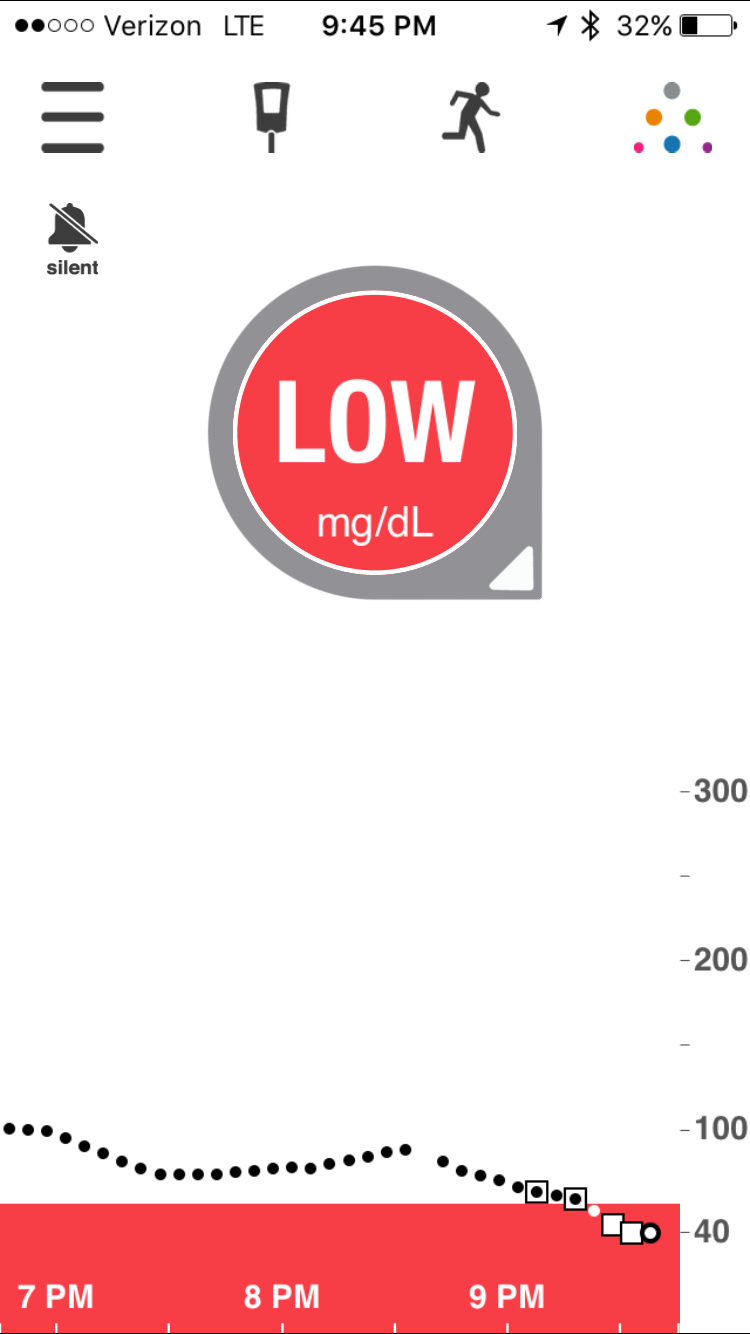
The lowest I’ve ever seen my sugar on my meter is 26.  I was just a few months into my diagnosis, had no clue what I was doing, and I have no idea how I didn’t fall over and wind up in an ambulance.  I was in Las Vegas with the friend who is now my chief sugar stalker, we had some margaritas with chips and salsa, and I guessed pretty randomly about insulin dosing.  Not a good combination and I’m fortunate that my friend was there to bring me chips, a roll, and…a beer to bring my sugar back up.  Now that I’m using a CGM, lows can’t sneak up on me quite the same way.  A couple of weeks ago I dosed for popcorn before a movie and settled down during the previews to enjoy my snack.  My body had other plans, and as I ate my sugar kept falling.  I left my seat so I didn’t interrupt the movie for anyone else and watched probably the first 30 minutes of “Jason Bourne” standing in the hallway to the theater entrance while simultaneously watching my sugar readings on my phone and chewing glucose tabs.  I ate popcorn and glucose and I was still falling.  Eventually the number did what it was supposed to do and got back over 100, but not before I fell below 40 on the Dexcom.  Anything below 40 doesn’t register a number, so the reading on my phone and that of all 3 sugar stalkers was just “LOW.”  The only symptom that time was I felt a little shaky.  No panic, no brain crisis, just focusing on managing the situation.  Sort of a controlled panic.  I don’t ever want to see that reading again, but if I do I hope I’m in as much control as I was the first time.

As I've said before, T1 is a roller coaster.  Not just the highs and lows, but the emotional impact from both extremes.  Highs are frustrating and feel like failure.  If I didn’t eat those fries at dinner, this wouldn’t happen.  If I calculated my insulin right, this wouldn’t happen.  Lows…lows feel like failure too.  If I calculated my insulin right, I wouldn’t be in this mess.  If I’d been eaten something to get myself a little higher before I went to bed, I’d still be sound asleep around 100 right now instead of lying here awake watching and waiting for the CGM curve to turn.  It goes on and on and will make you crazy if you let yourself think that way.  And that leads to the message that I am, that we are, greater than the highs and lows.  I’m going to succeed, I’m going to screw this up, and I’m going to keep trying because T1 is about so much more than a number.  I am much greater than any number.

This is what I saw on my phone that night at the theater before things turned around.  The trend line shows me dropping from somewhere near 100 to 40 in just about an hour.  I don't know why.

Friday, August 5, 2016

Every Day is the Same...but Different

Spending an evening with an old friend a couple of weeks ago, I realized how little people know about what goes into living with Type 1 diabetes (T1).  We ordered pizza, and when I thought I had about 15 minutes left until dinner I injected insulin #1 to cover the bread I was about to eat.  My body, the insulin and the pizza guy weren’t all on the same timeline, so my sugar dropped before the food arrived.  With falling sugar, I worked to balance the insulin with some M&Ms and glucose tablets to get my number up before dinner.  When I injected insulin #2 not long after that, my friend’s reaction was basically “wait, now what?”  That’s on me, not on her or anyone else — I’ve never told her about the details of what goes into T1.  How could anyone know about the constant battle if they haven’t watched in person or heard about it directly?  T1 can be a roller coaster or a calm drive through the countryside depending on the day.  This is my attempt to fill in some of those gaps.  It’s on the long side, so bear with me!

The first and last thing I do every day is manually check my sugar (a.k.a. my “digit”) on a glucose meter.  Before I got my Dexcom CGM last month, I typically poked my fingers somewhere between 8 and 12 times a day.  Now that I have the CGM I still have to use finger sticks to calibrate it at least twice a day.  Right now I’m doing that to start and end the day and somewhere else in the afternoon or evening.  If I go to the gym, I check right before I work out.  Because my sugar can drop pretty significantly during cardio activity, that’s the time of day I’m most worried about knowing exactly what’s happening and want to make sure my CGM is accurately reading my level.  The rest of the day, I’m able to check in with my CGM to see where I am, before and after meals, before and during meetings, and any other time I want to know how I’m doing.  I need to know where I am to know what I need to do to keep my sugar as close as possible to where I want it to be.

Where do I want my sugar to be?  In a perfect world it wouldn’t be any different than a person without diabetes.  For those who like numbers, that’s below 100 when I wake up, under 110 before I eat, and no higher than 140 after meals.  In practice that’s not always easy, especially that digit after meals.  That's because anything I eat raises my sugar.  That doesn’t just apply to sugary foods or high carb things that digest into sugar, like french fries.  It’s just about everything, including proteins like beef and chicken even in the absence of any carby stuff.  So for nearly every meal and snack, I need to take insulin before and/or after eating to keep my sugar from blowing up to 200 or beyond.  That’s insulin #1 in this story, the fast acting shots I take to adjust for food.  In a non-diabetic person, the pancreas works before, during and after meals to keep glucose in a healthy range.  In my world, I play that role with insulin pens and needles.  In diabetic terminology, those are called insulin boluses.  In my vernacular I’m either dosing or shooting up.  Eat food, dose.  Go high, dose again.  Go low and need to get back up to a healthy number?  Depending on the time and place, my solutions range from glucose tabs that are chewable sugar bombs in (not so) fabulous fruit flavors, to choosing a beer instead of a glass of dry (low sugar) wine during a night out.  The choices are many!  I will say there’s nothing quite like chewing raspberry flavored sugar at 4 AM…except the resulting taste left in your mouth when the alarm goes off 2 hours later.  However, I’ve yet to work up the motivation to get up and brush my teeth after a late night low!

Insulin #2 is my basal medication, or what I call my “nightly.”  This is a long acting insulin that is designed to keep my sugar fairly consistent in between meals, including overnight.  Its long duration of action means I only need one dose a day, compared to the original long acting insulin I took that was injected every 12 hours.  There are a lot of things that impact blood glucose other than food, including the release of hormones that happen naturally 24/7.  #2 is to keep me at a healthy base sugar level, and my dosage is independent of what I’ve eaten.  One guaranteed impact on that dose in my life is exercise.  If I walk on a treadmill at least every other day or so, my dose is lower than if I don’t exercise.  Cardio increases my sensitivity to insulin, so I take a little bit less when I’m working out consistently. 

Every day with T1 is a balance.  It’s a balance between food, insulin, exercise and all the other unseen factors in life and inside my body that can impact my sugar.  No two days are the same, even if all of my inputs to the process like food and exercise are identical.  That balancing act that my friend saw not so long ago happens every day, but I don’t tend to discuss it with many people.  It’s my routine now, even though there’s no such thing as a routine day.  Wake up, check sugar and dose if needed.  Eat, work, keep monitoring sugar via finger poke or CGM.  Dose for food, dose for unexplained highs, throw back some M&Ms or a bite of brownie to correct random lows.  Go to the gym to help manage sugar levels, but be careful to make sure my sugar is high enough going in that I don’t have a dangerous low that could cause me to pass out and fly off the back end of a treadmill.  Eat, socialize, sleep and keep checking sugar to adjust for anything known or unknown that’s causing the CGM trend line to deviate from a happy path.  Wake up tomorrow and start the cycle over again, wondering what tricks my body may have in store for the day.  And if you think I was joking when I said “bite of brownie,” I really mean that and I pulled it off recently at work.  It doesn’t take much, so willpower is important!  I eat M&Ms in increments of 1 at a time now.  Who knew that was possible?!

I don’t talk about any of this in detail very often.  It’s my grind, not yours.  At the same time, the longer I fight T1 the more I see the need to improve awareness.  I want my family, friends and the people around me to know about this disease and my experience as much as they can without living in my shoes.  I don’t want sympathy; I’m fighting T1 and enjoying my life at the same time.  But I do want to open a window, even to the extent that it’s possible with a blog post, into what T1 looks like.  There is rarely an hour that goes by without me thinking about my sugar, or the impact and timing of my last and next meal, or whether I need another insulin shot, or whether I could wind up with low blood sugar and have my brain let me down mid-sentence in a meeting.  This is Type 1, and until researchers come up with a cure, this is my life.  It’s all day, every day, but as I’ve often told another friend about fighting T1, “I got this!” 

On a not so side note, my sugar the last several days has been amazing, running most of the time between 80 and 120.  I posted a 24 hour graph of my CGM readings on the Beyond Type 1 app the other day and another Type 1 responded with “holy cow, what are you doing?”  Pretty cool validation of a really nice week.  Here's my last 24 hours as of tonight, I'm heading into the weekend in a great place.